Best multivitamin for men
A practical guide to compare the options and choose according to your needs.
Read article
Liquid multivitamins vs drink powders vs capsules vs gummies: real absorption differences, cost per serving, who benefits from each format, and our recommendation.


Most people searching for a liquid multivitamin are really trying to escape pills. The good news: a morning drink is one of the easiest supplement routines to keep. The nuance: pre-bottled liquids are not automatically better absorbed, and drink powders often offer broader, more stable formulas.
This guide compares formats on practical criteria, without miracle absorption claims.
The search for a liquid multivitamin almost always starts with the same feeling: pill fatigue. Swallowing four to six capsules every morning is unpleasant, easy to forget and easy to abandon. Some people physically struggle with capsules; many more are simply tired of the ritual. A drinkable format solves a behavior problem more than a chemistry problem, and that is precisely why it works: the best formula is the one you still take in month three.
Under the "liquid" label, the market actually sells two different things, and the distinction matters more than any ad admits. Ready-to-drink bottles, where the vitamins sit in solution for months and need preservatives to survive. And drink powders, where the formula stays dry and stable until you mix it into water. Both give you a morning drink instead of pills, but they age very differently on the shelf, rarely carry the same formula breadth, and sit at very different price points per serving.
This guide walks through the honest comparison: what absorption claims are actually worth, how the four formats stack up on the criteria that decide whether a routine survives, what the math looks like per serving, and which product we recommend for the most common profile. Not sure a multivitamin is what your routine is missing in the first place? Take our vitamin needs quiz first, it takes about two minutes and gives you a profile to start from.
Liquid vitamin marketing leans hard on absorption, with claims that liquids absorb at dramatic percentages while pills pass through you intact. Here is the fair version. A dissolved nutrient does skip one step: the capsule or tablet has to disintegrate in your stomach before its contents dissolve, and poorly made tablets can genuinely fail that step. Quality capsules do not. For a healthy adult taking a well-made product, the end difference in nutrient status between a dissolved form and a swallowed form is modest.
Where the dissolved format earns real credit is comfort and context. People with sensitive digestion often tolerate a drink with breakfast better than a fistful of capsules on a light stomach. Fat-soluble vitamins, D, E, K and A, absorb better alongside a meal regardless of format, which is an argument for anchoring any multivitamin to breakfast rather than an argument for any particular format. And a drink you sip is harder to forget than a bottle in a cupboard, which loops back to the real advantage: adherence.
So read absorption claims with calibrated skepticism: the format you dissolve is not magic, the format you actually take every day is. What genuinely moves absorption quality is the nutrient forms on the label, methylcobalamin, bisglycinate and friends, a topic we cover in our methylated multivitamin guide.
The zero-effort option: open, pour a capful, done. The costs of that convenience are structural. Nutrients degrade faster once the bottle is opened, because they sit in solution exposed to oxygen. Formulas stay narrow, because not everything survives months in liquid. Preservatives and heavy flavoring are almost mandatory. And the price per serving of shipping water around is rarely favorable. Ready-to-drink makes the most sense for short courses or for people who genuinely will not tolerate any preparation step.
Powders keep every serving dry until the moment you mix it, which is why the most ambitious all-in-one formulas on the market are powders. Dry stability allows broad nutrient coverage, live probiotics, greens and amino acids to coexist in one scoop, and it lets brands publish transparent per-serving labels. The cost is fifteen seconds of stirring and, for premium products, a premium price. For a daily all-in-one routine, this is generally the strongest format, and it is the one our main pick uses.
Capsules remain the right tool for targeted, single-nutrient needs: one magnesium capsule at night, one vitamin D in winter. They travel well, taste like nothing and dose precisely. Their weakness is scale: the moment your needs broaden, capsule count climbs, and six-capsule mornings are where routines go to die. If your stack already looks like a small pharmacy, that is the signal to consolidate rather than add.
Gummies win the taste war and lose almost everything else: sugar or sugar substitutes, low doses per unit, and real difficulty carrying minerals in meaningful amounts. They have a legitimate niche for people who refuse every other format, and they are better than nothing. They are not a serious vehicle for a complete daily formula.
Honest absorption note: dissolved nutrients skip the capsule breakdown step, but for most healthy adults the end difference is modest. Pick the format for consistency, not for magic bioavailability.
Format debates become concrete when you divide price by servings and compare what each serving contains. A cheap capsule multivitamin can cost very little per day, but it covers a narrow slice: if you then add a separate greens powder, an electrolyte mix, a probiotic and a joint product, your real daily cost quietly triples, along with the number of things you must remember to take.
An all-in-one drink powder inverts that math. The sticker price per month looks premium in isolation, but it is buying the consolidated basket, not one bottle among five. The honest comparison is your current total stack cost against the all-in-one price, minus the value of the products it retires. For some people the all-in-one is genuinely cheaper; for others it is a small premium paid for simplicity and adherence. Both are rational, as long as you ran the comparison against your real shelf rather than against zero.
Two practical notes complete the math. Discount codes move premium products meaningfully: ten percent on a monthly subscription compounds over a year. And abandoned supplements cost infinite dollars per benefit: whatever format you choose, the units you never take are the most expensive ones you own.
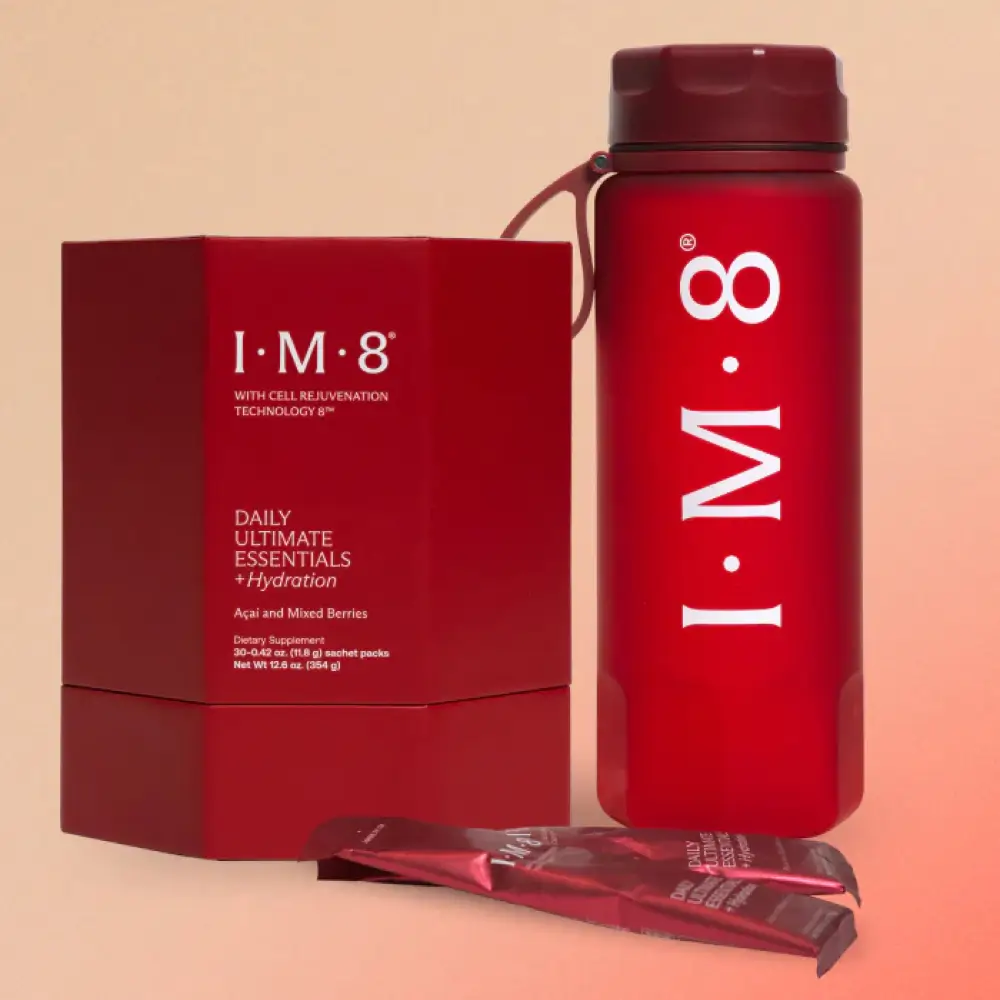
Daily Ultimate Essentials by IM8 is the drinkable pick of this comparison: a powder mixed in water each morning that brings together the coverage of a multivitamin and additional daily essentials in one glass. The published label is the argument: named nutrient forms, including methylated B12 and folate and magnesium bisglycinate, plus themed complexes covering greens, probiotics, electrolytes and amino acids that no ready-to-drink bottle could keep stable. It directly replaces the pile of capsules that pushes people toward liquid formats in the first place.
The trade-offs, stated plainly: it is a premium product at a premium price, the taste is a personal variable you will live with daily, and as an all-in-one it is oversized for someone who needs exactly one nutrient. It earns its price as a consolidation of several products, not as an addition on top of them.
If your interest is narrower, a targeted capsule product remains the rational choice. Collagen+ Eternity by Granions, for example, serves a specific skin and joint comfort intent rather than broad coverage, and it appears alongside the other targeted options in our main comparison ranking. Match the format to the size of the need: a broad need earns a drinkable all-in-one, a narrow need earns a capsule.
Code verified and valid for 2026
Marketing often overstates this. A liquid or dissolved powder skips the capsule disintegration step, which can matter for people with digestive sensitivity, but for most healthy adults the difference in real nutrient status is small. Choose the format you will take consistently.
A liquid multivitamin is sold ready to drink in a bottle, usually with preservatives and a shorter shelf life once opened. A drink powder like IM8 is mixed in water at the moment you take it, which allows a broader formula and better stability. Both are drinkable routines rather than pills.
People with pill fatigue, people who dislike or struggle with swallowing capsules, and people replacing a stack of several bottles with one routine. A morning drink is also easier to anchor to an existing habit like breakfast.
IM8 Daily Ultimate Essentials is a powder you mix into water, so it becomes a drink at the moment of use. It is not a pre-bottled liquid. We class it as a drinkable all-in-one formula, which is what most people searching for a liquid multivitamin actually want.
Yes, and this is the underrated drawback of ready-to-drink bottles: once opened, nutrients sit in solution, exposed to oxygen, and degrade faster than dry forms. Powders keep each serving dry until the moment you mix it, which is why they generally hold their formula better across a month of use.
Gummies win on taste and lose on formulation: sugar or sweeteners, limited doses per gummy, and difficulty including minerals like magnesium in meaningful amounts. They can help children or adults who refuse everything else, but for a complete daily formula they are the weakest of the four formats.

To continue reading, also see Best multivitamin for men, Daily supplement side effects and Methylated multivitamin guide.

A practical guide to compare the options and choose according to your needs.
Read article
A practical guide to compare the options and choose according to your needs.
Read article
A practical guide to compare the options and choose according to your needs.
Read article Partner offer IM8 Daily Ultimate Essentials is the most coherent all-in-one routine for someone searching for a...